
4. Patent Listing proposed by the Guidelines Open to Abuse
Patent listing is not a prerequisite for implementing Article 18.53.1 of the CPTPP. Experience from countries that have incorporated patent listing into their linkage regimes shows that such systems are prone to abuse. Patent holders have used listing strategically to include irrelevant or weak patents, creating unnecessary barriers for generic entrants and triggering stays of the regulatory process. Rather than safeguarding legitimate rights, patent listing will be used to deter competition and delay the entry of more affordable medicines.
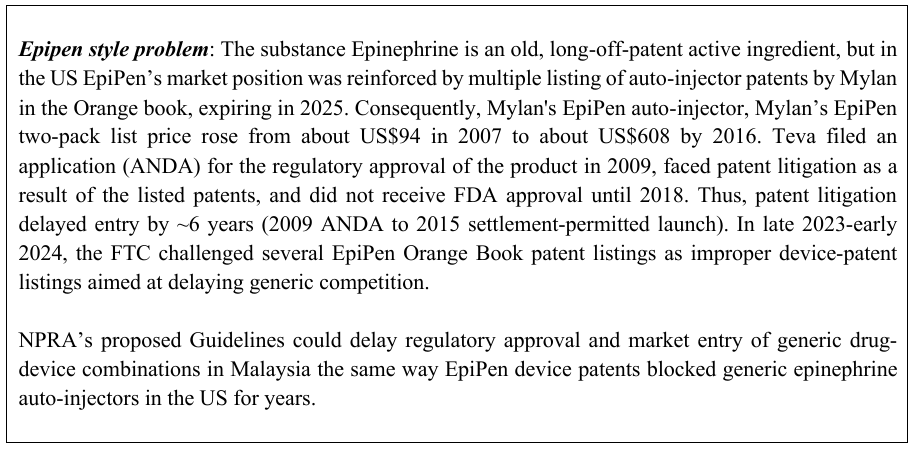
In the US, improper listing has become a major concern. Its Food and Drug Administration (FDA) acts in a purely administrative capacity, taking patent declarations at face value. But the US Federal Trade Commission (FTC) has found many instances of improper patent listing aimed at delaying generic competition. In 2023, the FTC issued a policy statement explicitly stating that “Brand drug manufacturers may be harming generic competition through the improper listing of patents in the Food and Drug Administration’s (“FDA”) Approved Drug Products with Therapeutic Equivalence Evaluations, known as the “Orange Book.” It further notes in its policy statement that: “Improper Orange Book patent listings may disincentivize investments in developing a competing product and increase the risk of delayed generic and follow-on product entry, reducing patient access to more affordable prescription drugs and increasing costs to the healthcare system. Given the enormous profit margins of many branded drugs, even small delays in generic competition can generate substantial additional profits for brand companies at the expense of patients.”
The Chair of the FTC has also added that “[i]mproper patent listings in the Orange Book illegitimately delay or lock out generic manufacturers from entering the market, depriving Americans of access to lower-cost medicines and drug products”. In 2025, the FTC challenged more than 200 improper patent listings.
In June 2005, a report of the United States House of Representatives Committee on Government Reform Minority Staff, highlighted the impact of patent linkage on access to generic medicines and noted that “even the FDA does not have adequate expertise or resources to review the applicability of patents, and it has been unable to prevent abuses of the system by patent holders that have led to delays in the availability of generic drugs”.
An example of improper listing:
Similar challenges exist in Canada that also requires patent listing as part of its linkage mechanism. The Canadian government and its Supreme Court recognised that the patent linkage system was abused by the originator companies by continually adding irrelevant and frivolous patents to the list of patents notified to the regulatory agency, which were then used to block the entry of generic competition for a long time at huge cost to the Canadian health system.This is more so when the scope of the linkage system is expansive and includes secondary patents as suggested in the NPRA Guidelines.
We reiterate that patent listing is not a requirement for implementing Article 18.53.1 of CPTPP. In any case, there is significant uncertainty in the Guidelines as to how the listing will operate.
According to the Guidelines, the Category 2 applicants (i.e. the patent holders of the originator product) will list the patents granted and pending patent applications that are applicable to their product. Generic companies falling within Category 3 (i.e. generic applicants that will market the generic product once the patent expires) are also expected to list all active patents. In all likelihood, the list of patents by Category 2 applicants will differ from the list of patents of Category 3 applicants. Since the Guidelines allow patent evergreening, it can be expected that the Category 2 applicants will continue adding patents to the list and extending the patent expiry date. However, if the Category 3 applicants are of the view that relevant patents have expired, but Category 2 applicants have a separate list of patents, what are the implications? NPRA is rightly indicating that it will not be involved in any patent dispute; however there is legal uncertainty on how any difference in the listing of patents will be addressed and the effect on the registration of the generic product.
Section 6.2.2 of the Guidelines expects the generic company to “ensure that the product is marketed only after the patent of the corresponding NDP has expired”. This suggest that NPRA expects generic companies to be guided by the list of patents provided by the Category 2 applicants, when determining the patent expiry date. This approach will motivate the originator to continue listing frivolous, irrelevant patents as a deterrent to generics entering the market.