
 PETALING JAYA: Several groups have called for the withdrawal of a proposed guideline by the National Pharmaceutical Regulatory Agency (NPRA) on patents, saying it risks hampering the production and sale of affordable generic medicines to those who really need them.
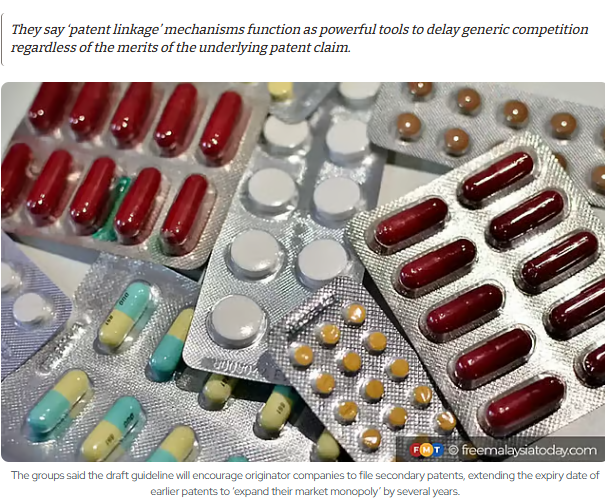
The groups said international experience and studies show that such “patent linkage” mechanisms function as powerful tools to delay generic competition regardless of the merits of the underlying patent claim.
Read more : https://www.freemalaysiatoday.com/category/nation/2026/05/02/npra-patent-guideline-may-hinder-affordable-generics-warn-groups
“The proposed guideline (in its current form) must be withdrawn.“It risks erecting procedural barriers that shield originator companies from competition and place affordable medicines beyond reach for those most in need,” they said in a joint statement.
The groups are the Consumers’ Association of Penang, the Federation of Malaysian Consumers Associations, the National Cancer Society of Malaysia, the Malaysian AIDS Council, and the Third World Network.They said that in April, NPRA released for public consultation a proposed “Guideline on Implementation of Patent Linkage for Pharmaceutical Products in Malaysia”, presented as fulfilling an obligation under the Comprehensive and Progressive Agreement for Trans-Pacific Partnership (CPTPP).
The groups said the CPTPP sets out a minimum requirement of a simple system of notification to the patent holder before the marketing of a generic pharmaceutical product during the term of an applicable patent, plus adequate time to seek remedies.
However, they pointed out that the CPTPP does not mandate the more “intrusive” measures that NPRA proposes.
Under the proposed guideline, the originator companies would list their patents during the new product registration process.
Any company producing a generic version of the medicine seeking regulatory approval may undertake not to market its product until expiry of the patents in force.
“Where the generic company believes that the patent in force is invalid or will not be infringed by the marketing of its generic medicine, the generic company will have to notify the patent holder and product registration holder of the new product.
“Upon notification, the patent holder is then entitled to a 45-day window to initiate legal action which, once initiated, will trigger an automatic 12-month suspension of the regulatory approval process of the generic medicine,” the groups said in a joint statement.
They said Malaysian law already equips patent holders with robust remedies, including injunctions, if they can demonstrate to a court that infringement is imminent.
“This inversion of roles in the proposed guideline is dangerous. It converts a scientific regulator into an administrative gatekeeper for private intellectual property rights operating without the procedural safeguards a court provides,” they said.
Guideline encourages ‘evergreening’
The groups claim that the draft guideline would encourage originator companies to file secondary patents, extending the expiry date of earlier patents to “expand their market monopoly” by several years – a practice known as “evergreening”.
“Now the originator company will be even more motivated to file secondary patents. Each listed patent will extend the patent expiry date with the potential to trigger litigation and suspend the regulatory process of the generic applicant,” they said.